Lame XIII feat. W. Blake – 2026
Ebene brûlé (ancien stock), argent, or 18k, perles brûlées, corail sarde, turquoises d’Iran, turquoise chrome de Kyzil, cubic zircons, lapis, ivoir (ancien stock), stylo permanent
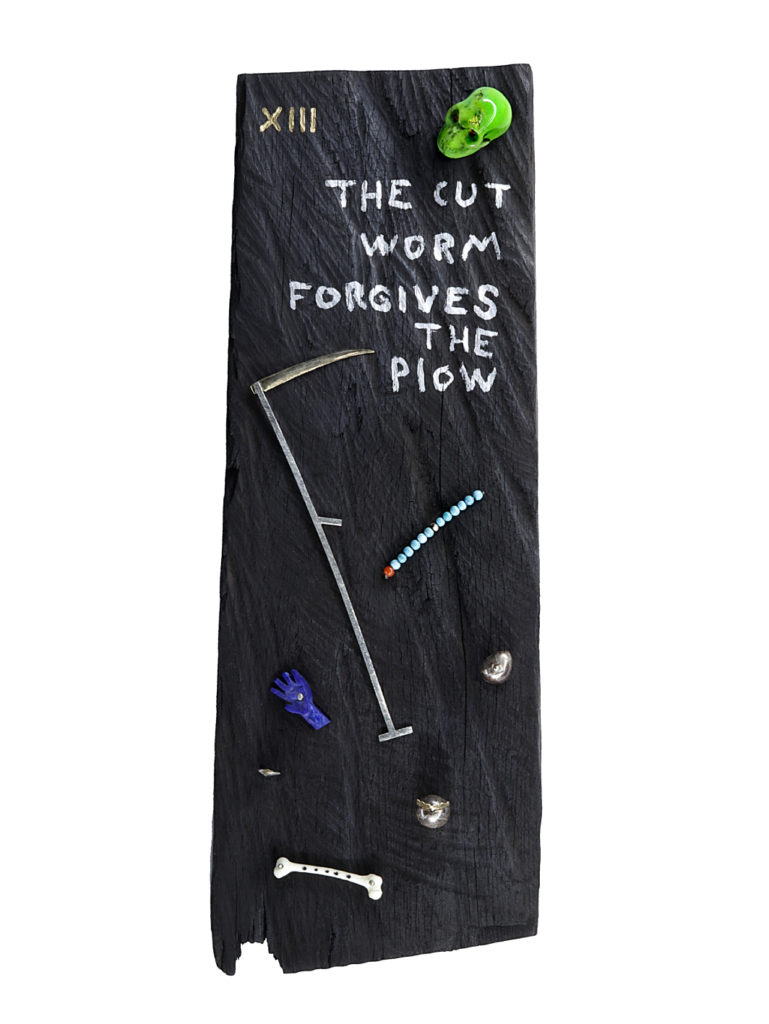
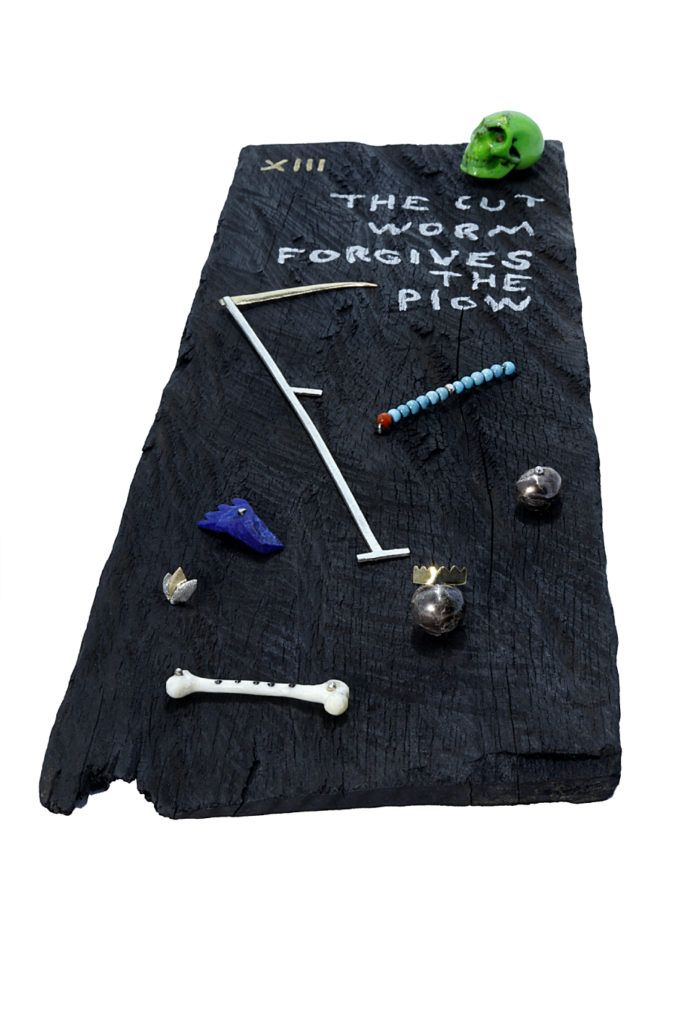
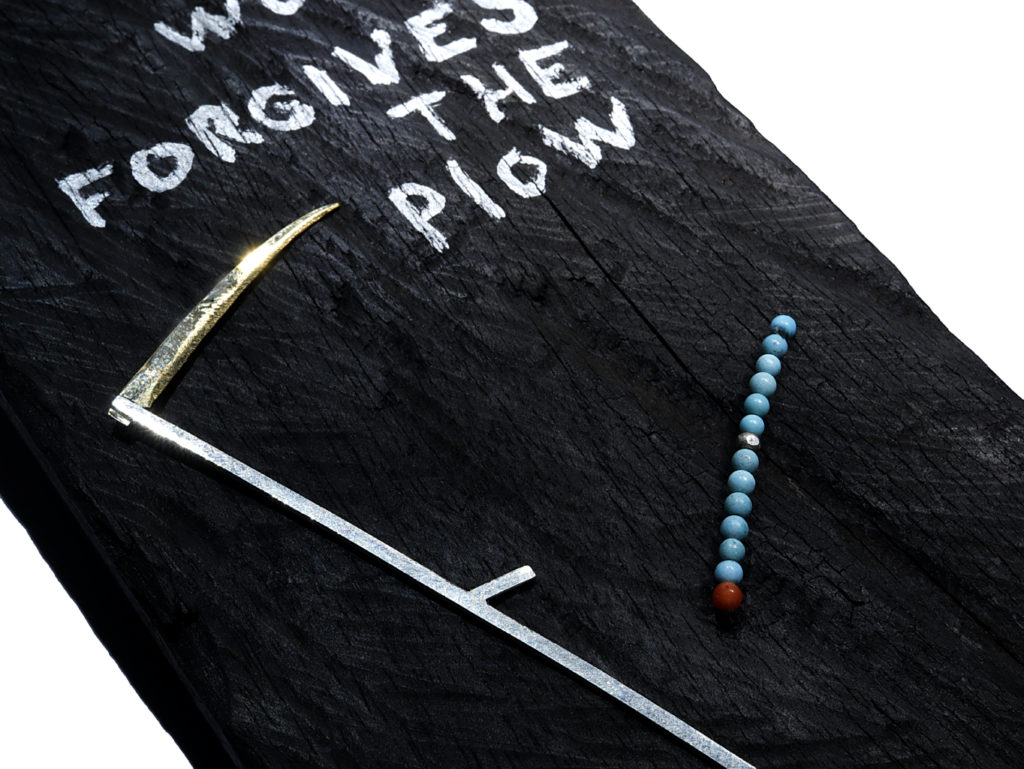
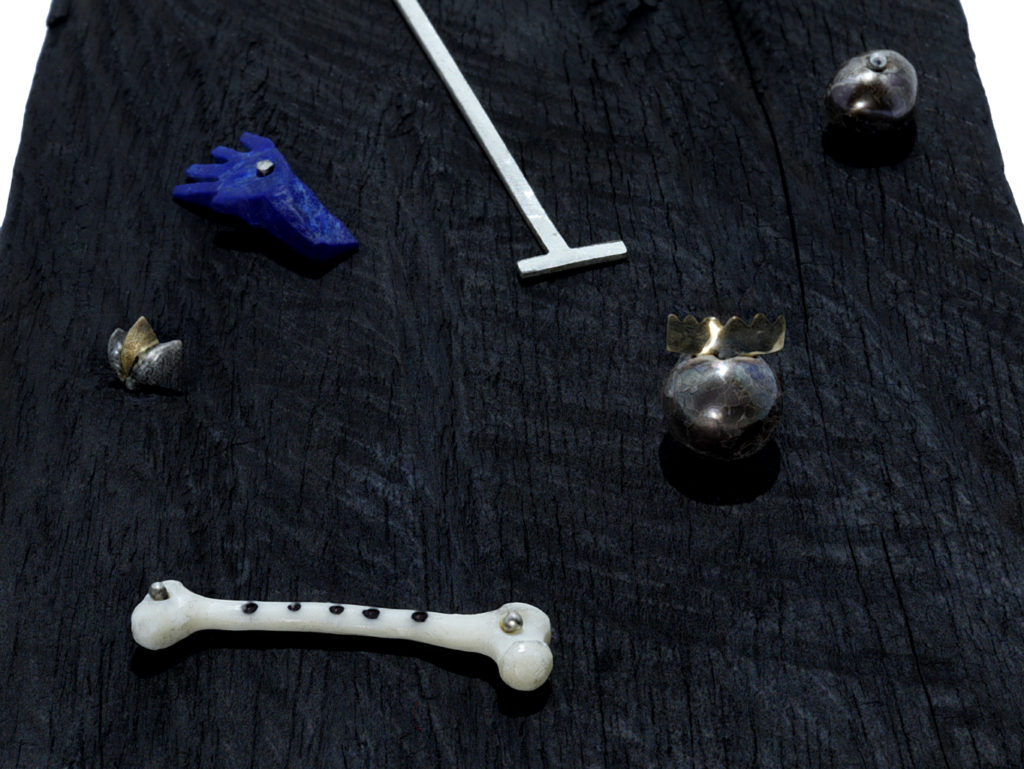
Cette broche s’inspire de la lame n° 13 du tarot, qui résonne avec une étape de transformation personnelle. Elle crée un dialogue inattendu avec un Proverbe de l’Enfer de William Blake, révélant les tensions entre destruction et renaissance, thèmes centraux de l’œuvre. Les matériaux proviennent de l’atelier de l’artiste et portent la trace du temps : ivoire ancien, ébène brûlé pour représenter le sol, perles brûlées pour les têtes, corail et turquoise formant à la fois la colonne vertébrale et le ver coupé. Ce croisement entre le proverbe et la lame ne se limite pas au texte gravé sur le bois : il s’illustre également dans la colonne vertébrale au nœud rouge, qui devient visuellement le ver coupé en deux. La pièce combine des matériaux nobles, comme l’or, et plus modestes, tels que le stylo, assemblés par soudure et collage. La flûte en os introduit une dimension sonore et symbolique, s’inscrivant dans le jeu de transformation. L’œuvre propose une double lecture : une perspective frontale dévoile le texte, la faux, le ver, la main et la flûte, tandis que la perspective « à ras du sol » met en avant le crâne, le végétal et les têtes, soulignant la dualité de la lame et du proverbe, entre destruction et régénération. La juxtaposition de matériaux anciens et contemporains renforce la dimension mémorielle et politique de l’œuvre, où chaque geste de transformation révèle la fragilité et la force de ce qui est porté.
Burnt ebony (vintage stock), silver, 18k gold, burnt pearls, Sardinian coral, Iranian turquoise, Kyzil chrome turquoise, cubic zircons, lapis lazuli, ivory (vintage stock), permanent marker.
This brooch is inspired by Tarot card No. 13, which resonates with a stage of personal transformation. It creates an unexpected dialogue with William Blake’s Proverbs of Hell, revealing tensions between destruction and rebirth—central themes of the work. The materials come from the artist’s studio and carry the traces of time: vintage ivory, burnt ebony representing the ground, burnt pearls for the heads, coral and turquoise forming both the spine and the severed worm. This intersection between the proverb and the card extends beyond the text engraved on the wood: it is also manifested in the spine with its red knot, visually becoming the worm cut in two.
The piece combines precious materials, such as gold, with more modest ones, such as the marker, assembled through soldering and gluing. The bone flute introduces a sonic and symbolic dimension, contributing to the theme of transformation. The work offers a dual reading: a frontal perspective reveals the text, the scythe, the worm, the hand, and the flute, while a “ground-level” perspective emphasises the skull, vegetation, and heads, highlighting the duality of the card and the proverb between destruction and regeneration. The juxtaposition of vintage and contemporary materials reinforces the work’s memorial and political dimension, where each act of transformation exposes both the fragility and the strength of what is carried.