
Gold is cheap – Klimt02
Published and edited by www.klimt02.net on 16th Febbruary 2026
https://klimt02.net/forum/articles/gold-is-cheap-nicolas-christol
We are living in a strange and unsettling moment, a period of historical upheaval. It would be foolish to see Donald Trump as the sole cause of these disruptions: he is only the catalyst. Economists and historians such as Yanis Varoufakis or Quinn Slobodian are warning us that we are entering an even darker and more brutal phase of capitalism. An unprecedented alliance between the right and far-right in Europe has also enabled the passage of the Omnibus law, which risks profoundly undermining environmental protection and human rights.
The field in which we operate has access to an almost infinite inventory of materials. We can perfectly well do without metal, pearls, coral, faceted stones, and even glue. We can ensure that we use only recycled gold or synthetic diamonds. Yet adaptability is merely a constraint that capitalism constantly imposes on those it leaves behind. Using less is sometimes a mode of action, but more often a mode of survival. The price of gold has surged since 2024, disrupting the financial balance of many artisans and artists. Yet the price of gold is only an abstract variable in a system with apocalyptic ecological and human consequences.
Contemporary artists have not been content to use gold merely as a material. As early as 1974, Peter Skubic organized a symposium to question the use of gold and to promote the use of steel. Many have directly questioned the fundamental role and perception of this metal in our societies, as in David Bielander’s Cardboard Crown (2015), an illusory piece made of yellow and white gold, which one might associate with figures such as Donald Trump, among others. Indeed. A closer look at the numbers reveals that cardboard generates far greater annual profits than gold production. Gold, however, remains more profitable per gram due to its extraction and the human and environmental violence it entails.
Thus, some artists create a play of illusion around the appearance or weight of metal, while others conceal it, approaching it from symbolic, ecological, or financial perspectives. It seemed pertinent to me to bring these works into resonance. Not to compare them or offer an out-of-context critique, nor to present my own attempts as answers. I am part of a collective attempt, and therefore part of our collective failure. But perhaps to encourage other experiments, other inquiries, sharing, and dialogue. On the question of risk, of improbability, of violence. On what activates or deactivates a work.
With Gold Macht Blind (1980) Otto Künzli enclosed a small gold sphere within a rubber ring. T
his work operates in three steps. Deactivating gold’s fetishism: the bracelet first deactivates gold as a universal equivalent, displacing its value through poetry and a subtle trick on weight and visibility. Engaging imagination: yet the fact that gold is invisible, while present in the title, generates a specific attraction to the promise of gold, what I would call an “El Dorado effect”. Recreating fetishism through fame and circulation: the more the work was sold or published, the more it became iconic. Some probably even purchased it with the rather pathetic calculation that a work by Künzli might gain value over time, eventually exceeding three times its original, low, and accessible price.
Christopher Thompson Royds’ 260 g bracelet, titled Lead Weights (2010), also engages with questions of perception and value. For him «a piece of jewellery worn everyday is most noticed when it is not worn; it’s physical absence felt more than its presence». As his grandmother’s jewellery was stolen before he was born; he reconstructs here the mental weight it took in his childhood imagination. This evocation also echoes a common technique used in the counterfeiting of gold jewellery. The ring is made of solid lead, with an 18k gold insert limiting contact with the toxic metal. The lead retains the traces of the casting process, while the gold insert was handcrafted. Like Schobinger’s inner tube, it partially conceals the gold, whereas Künzli hides it completely. The lead-gold combination more directly evokes alchemy, without falling into the trap of a chemical experiment. Here, transformation takes place through the senses.
Bernhard Schobinger created Tyre Tube (1978), a ring made from a bicycle inner tube with a 9ct gold insert. The inner tube symbolizes the vital breath,
pneuma, the movement initiated by the union of the soul and its outer casing, while the gold here serves as structural reinforcement, both protected and concealed by the rubber.
For his After Nature II (2022) series, he created six rings in steel, silver, gilded bronze, yellow gold, and red gold, each seemingly carved from a block of pyrite crystals. Called “fool’s gold” in alchemy, its resemblance to gold makes it a tool for learning transmutation and inner transformation. In the illustrated piece, the illusion is reversed: the pyrite itself is the imitation, made of real gold.
Alchemy is central to Ruudt Peters’ work and he makes a careful use of it, rarely massive, most of the time only as a delicate plating, a fragile leaf instead of a structural mass. We can think that for him the transmutation cannot really be accomplished, only approached, and be scratched without enough attention. His brooch Eva (2010) from the Anima series, is made of gold plated aluminium. But here no tools were used. Molten metal was dropped into water, giving birth to an organic, unpredictable form. Although it echoes industrial aluminium processes, the work is not a readymade; it emerges from a natural, uncontrolled process. Peters resacralises the object with a thin layer of gold, suggesting that transmutation remains a fragile state which requires care and attention. Peters’ use of gold in jewellery is both spiritual and economical, a mindful use of material in contrast to a history in which liturgy consumed vast amounts of blood and resources.
In these various examples, exchange value takes precedence over use value: gold, usually regarded as a universal measure of value, is here overshadowed by the social and speculative value of the artwork.
A heavy interlude
According to the World Gold Council over 6,000 years, at least 218,000 tons of gold have been extracted, with 54,000-64,000 tons remaining. About 3,000 tons are mined annually, 10%-15% artisanal. In 2025, consumption reached 2,175 tons for investment, 1,638 tons for jewellery, and 323 tons for industrial use. Industry accounted for most recycled gold (28%). The largest producers are China, Australia, and Russia; Switzerland refines 34% of the world’s gold, 11% from extraction, though domestic production is small (mainly Gondo). Several tens of tons of Swiss reserves came from the Nazi regime, and nearly 20,000 tons from South African Apartheid.
The NGO Swissaid estimates that over 450 tons of gold may be undeclared annually. Gold often occurs as flakes or fine particles, requiring crushing or alluvial concentration. It is extracted using borax or cyanide, and in small-scale operations, amalgamated with mercury, which is liquid at room temperature and evaporated by heating. Each year, over 700 tons enter the air and 800+ tons the soil and water. “Spongy” gold recovered this way still contains 2-5% mercury, later removed during refining.
If ingested, the metal generally passes through the digestive system and is unlikely to cause fatal poisoning, although it remains toxic. The vapors, on the other hand, cause severe neurological and pulmonary damage. Yet its most toxic form, methylmercury, is produced by bacteria in oxygen-poor waters and accumulates in fish and humans. Between 25%-33% of workers suffer chronic intoxication, with over 100 million people affected directly or indirectly. Other processes involve cyanide and high water and energy use. Between the 16th and 19th centuries, silver mining released twice as much mercury as is used for gold today.
The cost of gold extends beyond health and environment. Illegal mining generates $4 billion annually and fuels conflicts in Congo and Sudan (BHRC). NGOs have pressured the industry to adopt technical and communication measures, often greenwashed, such as “responsible gold” labels. initiatives have also been launched by artists themselves, like the Radical Jewellery Makeover, promoting the use of recycled metals in the production of artistic jewellery. But most recycled gold still goes to industry.
Dirty Gold: How Activism Transformed the Jewelry Industry (MIT Press, 2017), Michael John Bloomfield
Several reports on gold extraction, Swissaid
https://www.swissaid.ch/en/projects/the-two-sides-of-gold
The hidden cost of jewelry, 2028, Human Rights Watch
Against this background, some artists choose to confront gold more directly.
Ted Noten has long investigated the function and perception of gold in our society, from chewing gum cast in gold to gold-plated firearms. With irony and humor, his work exposes a distinctly profane obsession with the golden. He explores the world of finance with the ring
Evening Butterfly (2009), followed by its latest variant,
Muse (2025). This solid gold ring is sold online at a price displayed in real time, an abstract value that replaces another equally abstract and speculative one, that of the art market. Since the weight of the ring is not indicated, it becomes even more difficult to estimate the remuneration for the artist’s labor.
CSS-STCS (IL) (2025) is part of Transmutations, a series I made in 2025, examining the central role of gunpowder in capitalism. Its impact on the colonial project was decisive, enabling invasions, resource extraction, and the suppression of resistance. Later, techniques derived from this history, including so-called “less-lethal” methods, were imported back to Europe to control and repress social movements.The brooches and rings of this series are produced through explosion and named after different models of sting grenades. The deformation of the silver containers materializes state violence, while the gold pins form an invisible link between the device and the body: gold is not the value but the structural condition. Transmutation is not an symbolic elevation of the soul but a concrete dark process, turning bodies and nature into wealth through pure chemical violence.
Mian Wu created a series of objects titled Gold Jewellery (2015). In a Chinese jewellery production factory, she collected workers’ protective gloves and bras, compressing and molding them into objects shaped like ingots. She also recovered floor mats, from which she cut shapes resembling necklaces. Here we have a classic example of the reification of bodies and the fetishization of commodities. The market value of gold jewellery, abstract in nature, renders invisible the real labor of the workers necessary for production. Yet the artist then performs a symbolic requalification specific to the artistic field. By transforming the workers’ objects into artworks, she once again erases their labor. However, she circumvents this impasse by specifying the weight of the gold particles accumulated in the workers’ clothing (here 0,1 g). Yet gold itself remains invisible.
With Mercury makes Mad (2025), I sought to materialize the danger associated with the use of mercury in gold extraction. A one-gram gold bar, made in Switzerland, was ground into powder and inserted into a borosilicate glass tube with two grams of mercury. Technical constraints prevented the creation of a fully sealed tube. Moreover, the mercury must not be heated, at the risk of producing extremely toxic vapors. The technician thus knowingly reproduced an operation that is now completely prohibited, which historically affected many glassblowers specialized in the production of thermometers and fluorescent tubes. Here the gold remains invisible, amalgamated with the mercury. Wearing the bracelet or extracting the gold entails a risk of contamination and poisoning. Its speculative value is nullified, its iconic function disabled.
I was working on that text when Schobinger sent me an image of a bracelet he had made involving mercury and gold as well,
Kinetic Bangle (1971). A simple acrylic tube provides the structure while silicone ensures a proper seal, containing and isolating a substantial amount of mercury. Here gold is visible and functions both as an ornament and as protection for the sealing. The risk is contained, yet always present, a reminder of the unstable, volatile forces held within.
Poras Dhakan created a medal composed of a Persian carpet ribbon accented with pearls, and a sand cast brass medallion inscribed with the words Give it Back (2025). The project aims to encourage museum curators and decision-makers to return looted artworks held in Western museums. The brass medallion evokes the U-turn sign from British roads and symbolizes the objects and decorative elements removed from monuments such as Tipu Sultan’s Lal Mahal. It also contains fragments of synthetic diamonds, representing historic stones such as the Koh-i-Noor. In this way, Poras addresses another form of wealth extraction within the colonial apparatus, without resorting to the use of gold or real diamonds. The Persian carpet ribbon references Edward Said’s book Orientalism and once again illustrates an “El Dorado effect”: the way in which the desire for wealth (and exoticism) shapes our perceptions and actions. By subverting the military medal and its association with colonial conquests, Dhakan’s work reverses its symbolism: a paradoxical and futile reward that cannot, on its own, repair the damage caused by colonial spoliation.
Many contemporary artists have questioned the iconic and financial role of gold, such as Chris Burden, Maurizio Cattelan, Otobong Nkanga, or Gabriel Rico. Yet contemporary art suffers from a systemic problem: its transformative power is altered or even disabled by the institutional framework in which it operates, as well as by the funding required for its production and acquisition. A political artwork that costs €20,000 to produce and, by default, sells for €40,000 immediately shifts its function from critical commentary to class violence. This is without even considering the environmental impact of production.
In comparison, contemporary jewellery remains relatively affordable and less subject to speculation, retaining the extraordinary power of being worn and embodied. But in 2026, can we speak of gold through jewellery without acknowledging the violence embedded in its production? While ecological concerns are central in contemporary jewelry, they can sometimes obscure fundamental dimensions of capitalism, leaving its mechanisms of violence and exploitation in the shadows. Does the near-universal use of gold in the production of artistic jewellery reflect an inability to interrogate the necropolitical context (Achile Mbembe) in which this production takes place? What about silver?
Nicolas Christol
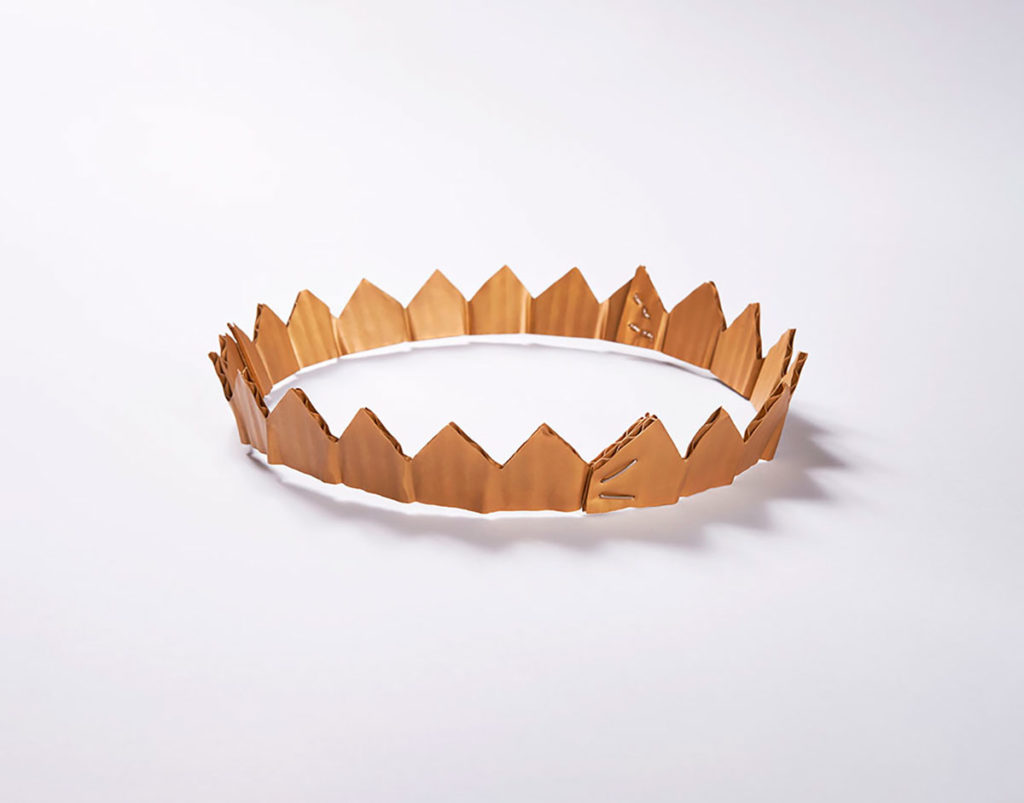
David Bielander
Neckpiece: Cardboard Crown, 2015
Yellow gold with white gold staples
Photo by: Dirk Eisel
Part of: Museum of Arts and Design New York
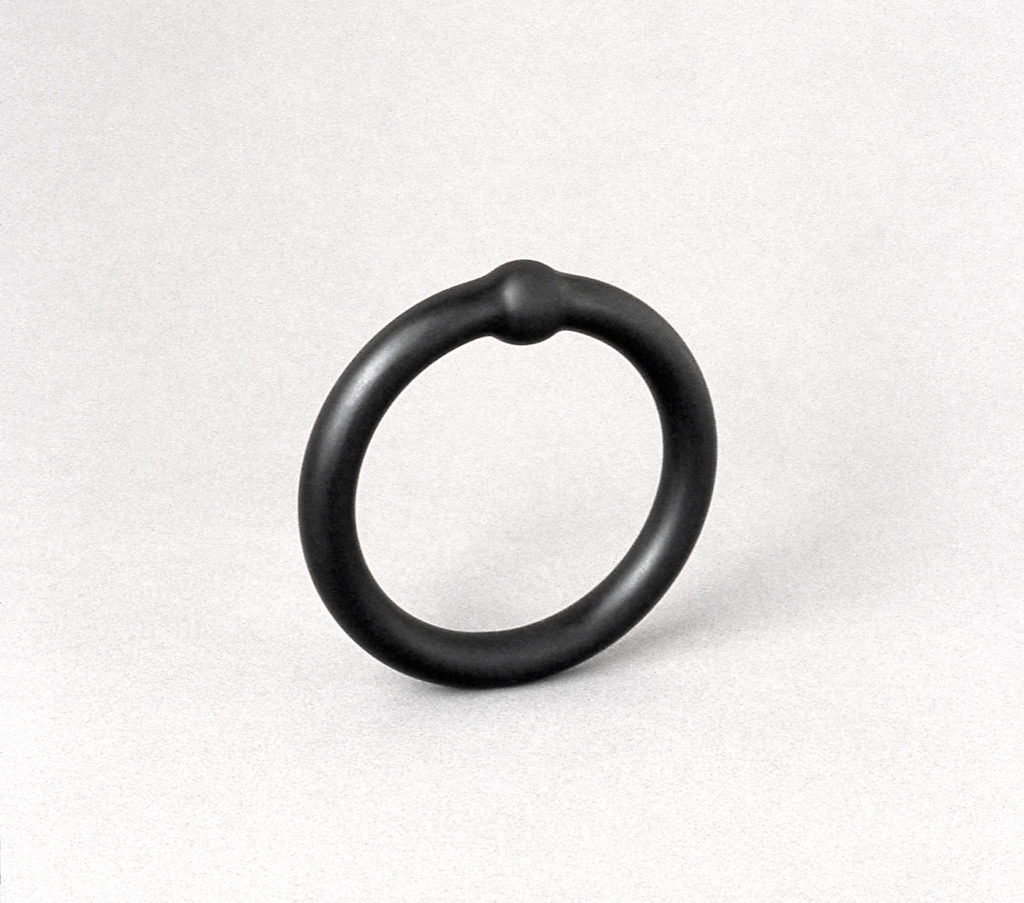
Otto Künzli. Bracelet: Gold Macht Blind (Gold makes you blind), 1980.
Synthetic rubber, 18k gold. ø 7.5 cm
Photo by: Otto Künzli
Christoper Royds Thompson. Bracelet: Lead Weights, 2010. Lead, 18k gold.
Photo by: Christoper Royds Thompson
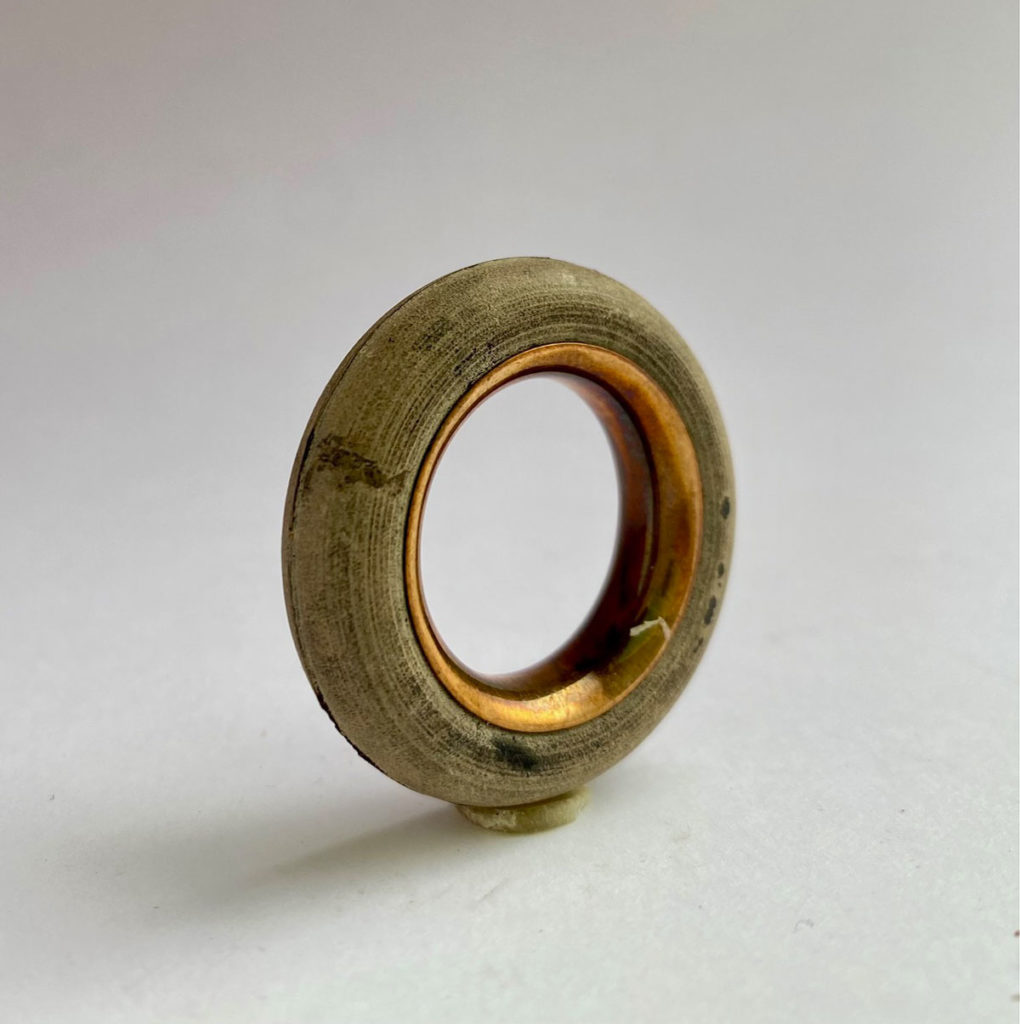
Bernhard Schobinger. Ring: Tyre Tube, 1978. Rubber, 9k gold
Photo by: Bernhard Schobinger
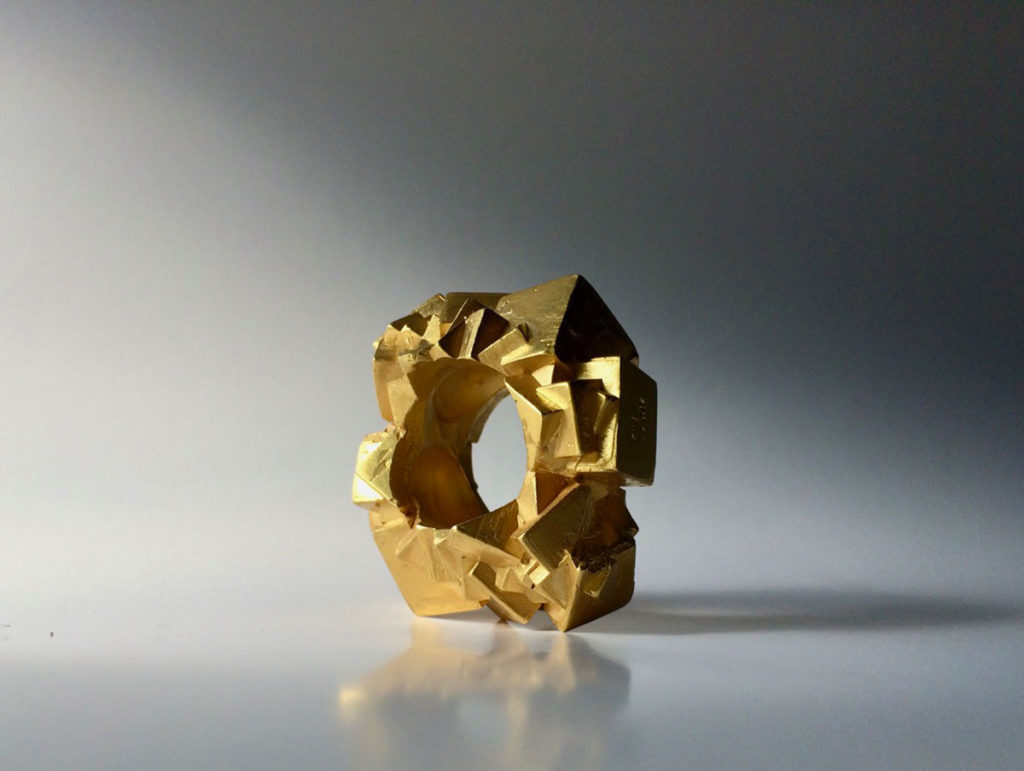
Bernhard Schobinger. Ring: After Nature II, 2023. Red gold 750.
Photo by: Bernhard Schobinger
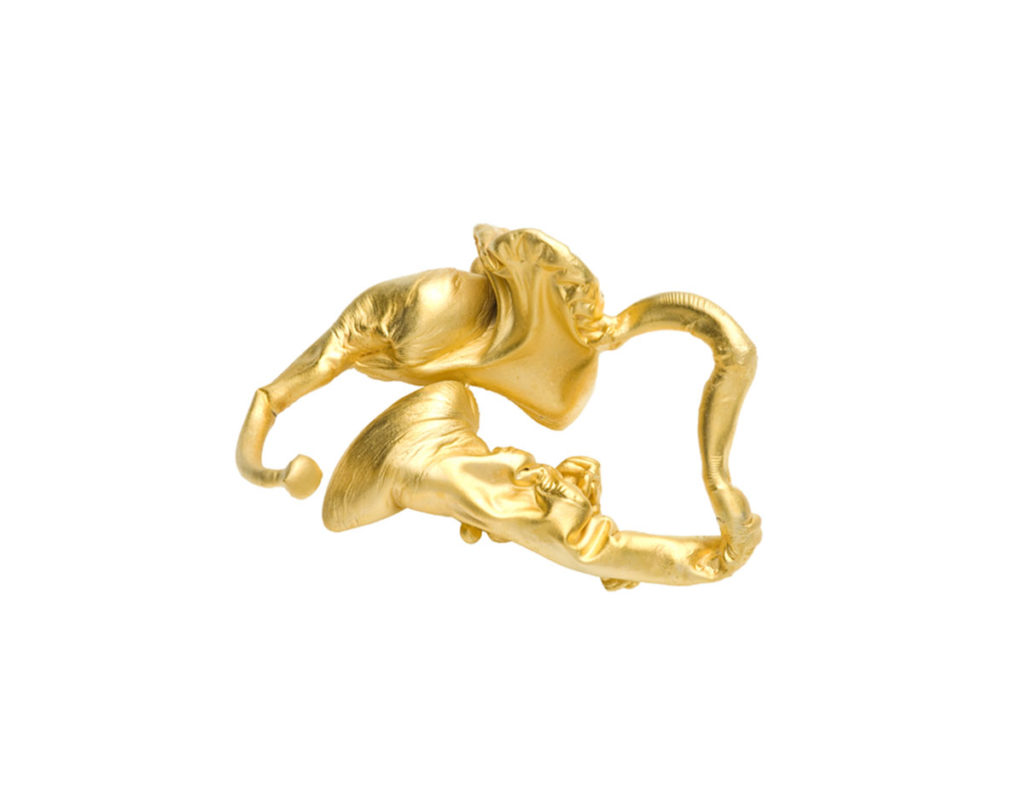
Ruudt Peters. Brooch: Eva, 2009. Gold-plated aluminium. 3 x 1 x 1 cm
Photo by: Rob Versluys
From series: Anima
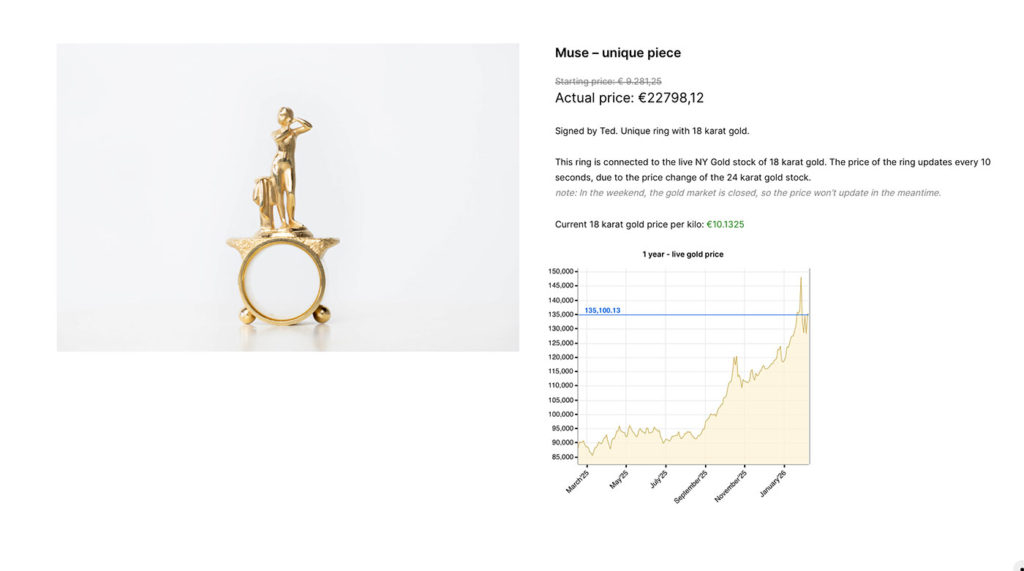
Ted Noten. Ring: Muse, 2026. 18k gold, NY gold stock live feed.
Photo: ATN
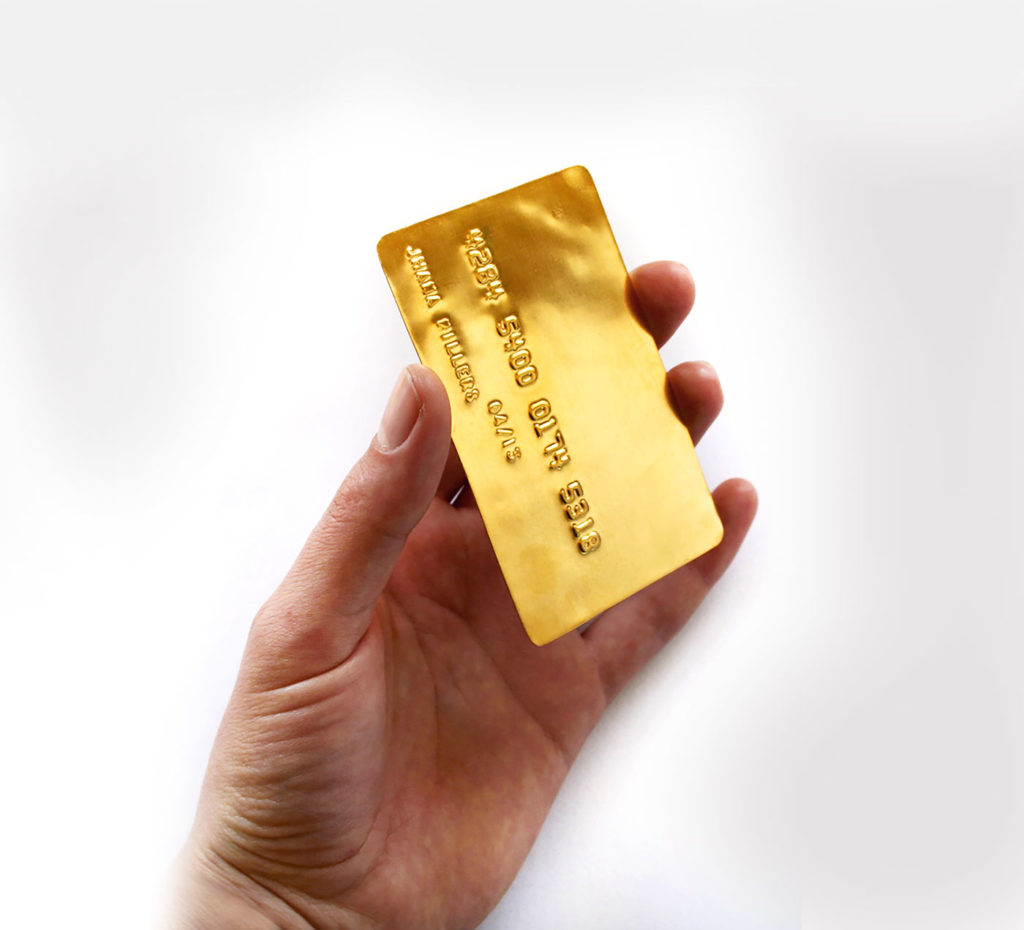
Jhana Millers. Object: Valid Thru, 2011. 24k gold
Photo by: Jhana Millers
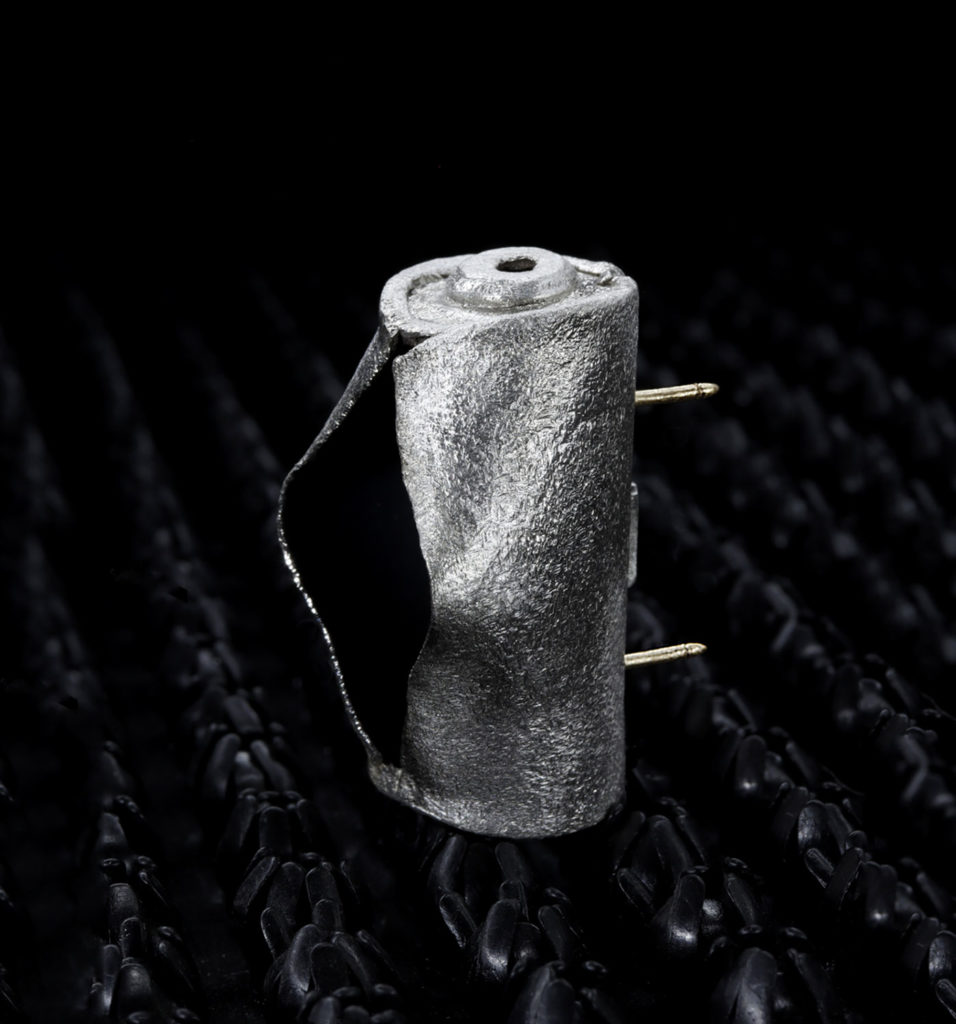
Nicolas Christol. Brooch: CSS‑STCS (IL), 2025. Silver, patina, gold
Photo by: Nicolas Christol
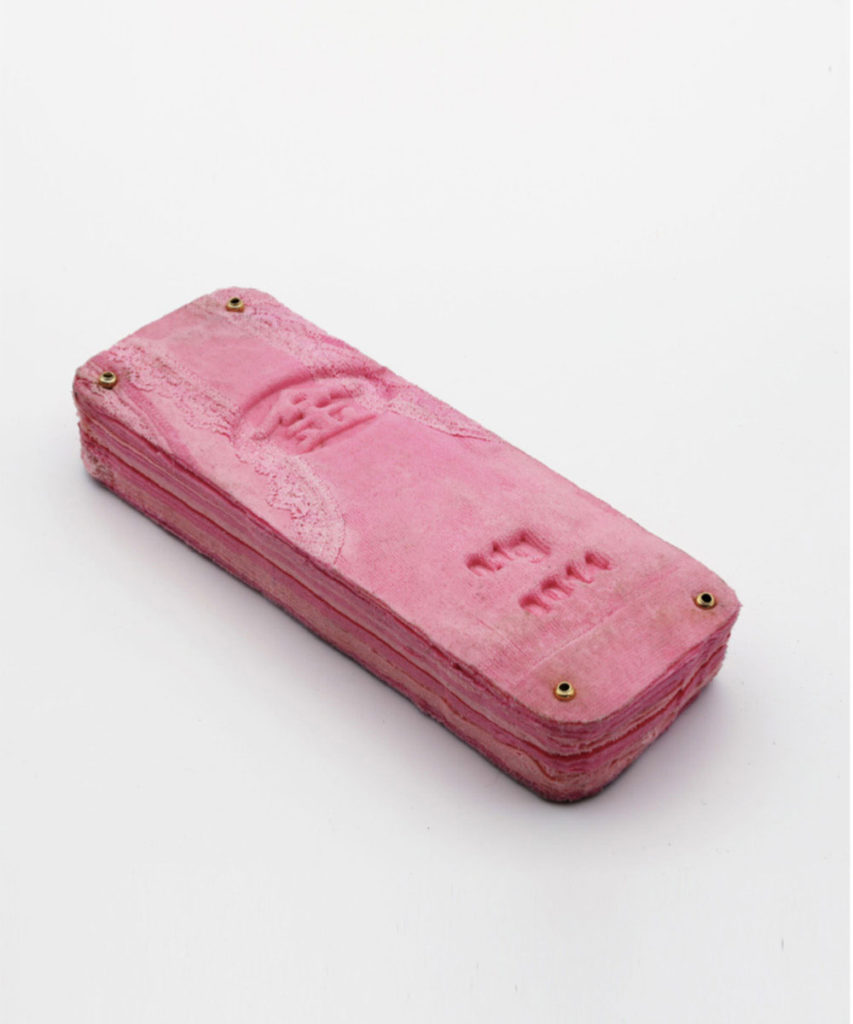
Mian Wu, Object: Bra Gold, 2015. Bra used in the gold factory, brass, 0,1 g of gold.
18 x 5 x 7 cm. Photo by: Mian Wu
From series: Gold Jewelry
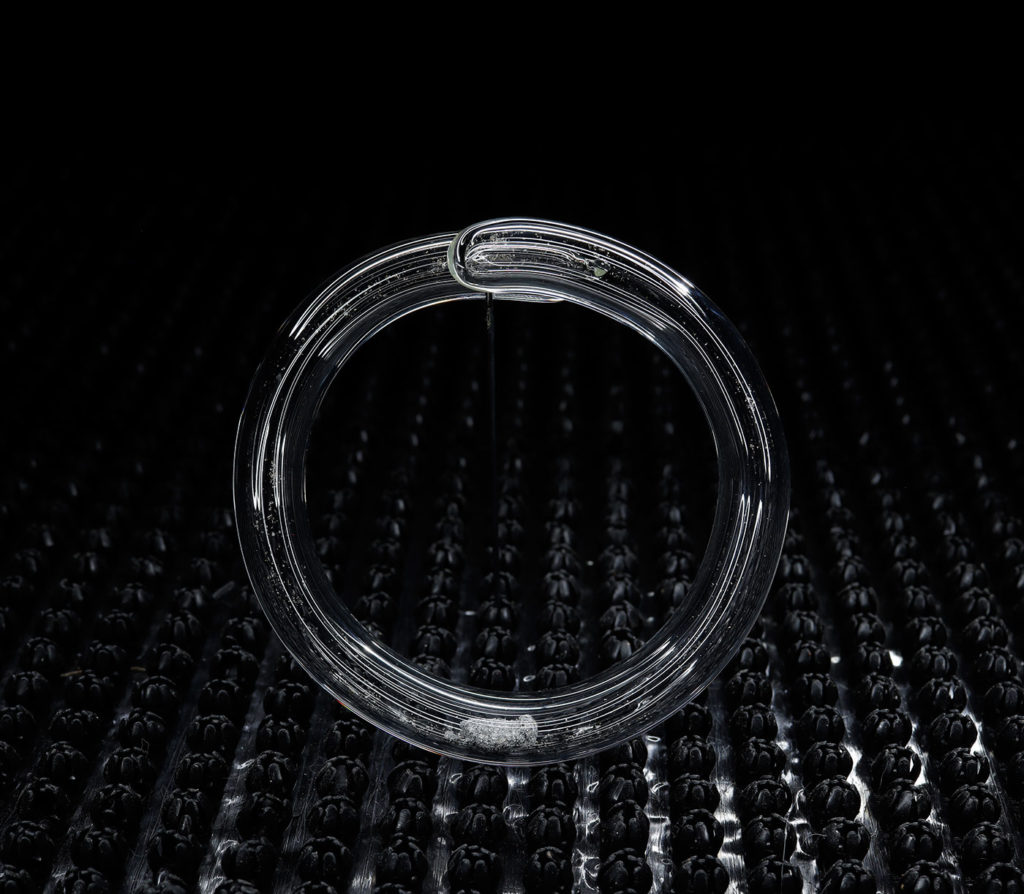
Nicolas Christol
Bracelet: Mercury Makes Mad, 2026
Hand-blown borosilicate glass, fine gold, mercury
Photo by: Nicolas Christol
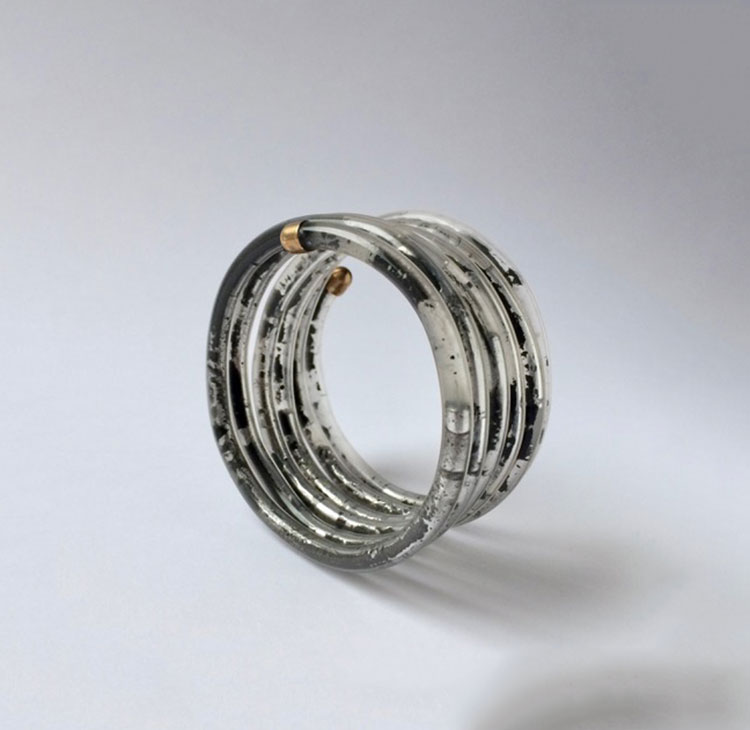
Bernhard Schobinger. Bangle: Kinetic, 1971. Acryl, Mercury, Gold, Silicone.
Photo by: Bernhard Schobinger.
Part of: Bosshard Collection. Courtesy: Kunstzeughaus Rapperswil SG, Bosshard Collection.
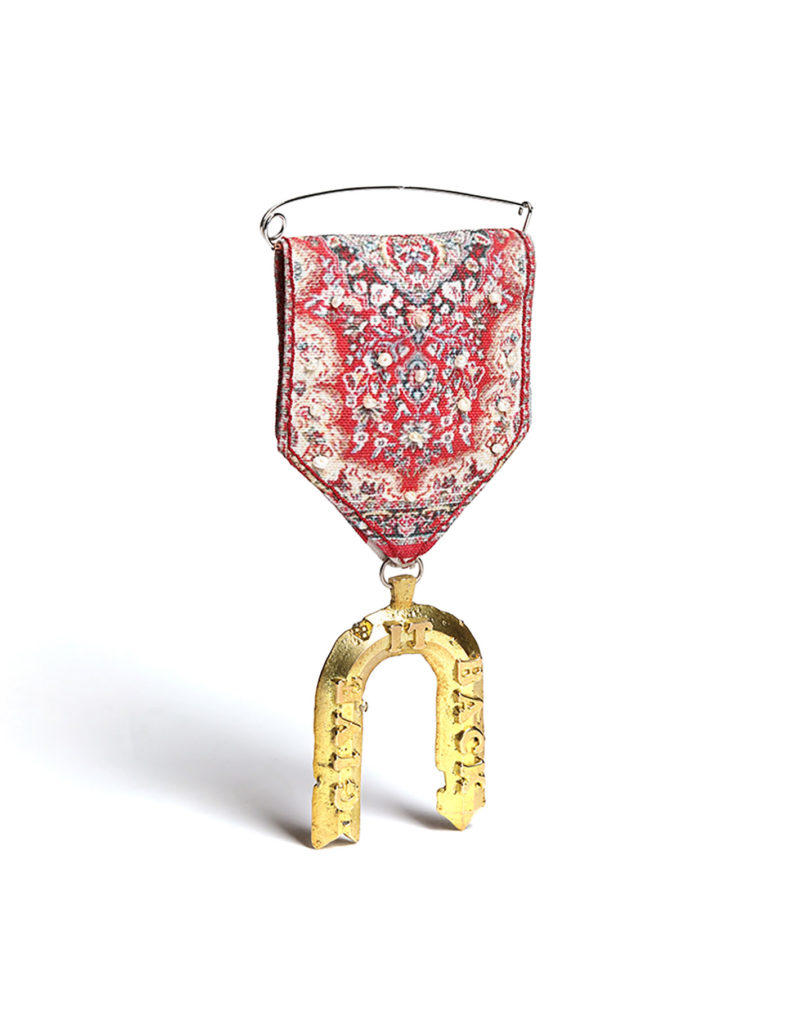
Poras Dhakan. Brooch: Give It Back, 2025. Brass, lab-grown diamond chips, plastic polymer carpet, steel pin, brass tube, silver loop, pearls
Brass: 5.5 x 6 x 3 cm with ribbon: 5 x 12 x 0.2 cm
Photo by: Nima Ashrafi
From series: Give It Back