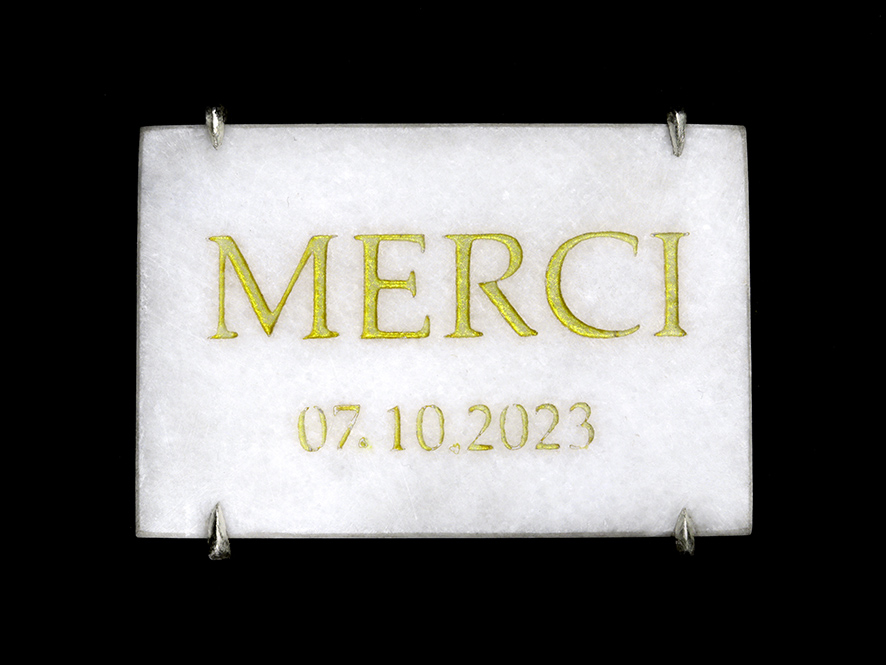
Merci – 2024
Ex-voto / Nevin Arig (tu/ch) – Mehdi Bouhanek (tn/ch) – Marcia Cirne (br) – Nicolas Christol (ch) – Margo Csipő (usa) – Nora Delanoë (ch) – Robin Deriaz (ch) – Cecile Giovannini (it/ch) – Benedict Haener (ch) – Ophélie Hilbert (fr) – Margot Jud (ch) – Otto Künzli (ch/de) – Nicholas Marolf (ch) – Ruudt Peters (nl) – Melane Zumbrunnen (ch) / décembre 2024, www.espaceborax.ch
Merci
Marbre (marbrerie J. Marolf), peinture dorée, argent
Cet ex-voto, monté en broche, fonctionne comme un piège sémiotique.
L’œuvre n’offre ni récit, ni position morale, ni distance critique rassurante. Elle produit une insolubilité. La reproduction d’un mécanisme de paralysie — un régime de signes intrinsèque au fascisme.
En tant qu’objet porté, l’œuvre introduit le corps comme lieu d’exposition, impliquant le porteur dans la circulation de ses signes.
La broche ne protège aucun corps et n’offre aucun récit réparateur.
Elle est susceptible de blesser à la fois les victimes juives et palestiniennes, refusant toute position de confort face au génocide et à la nécropolitique. Cette œuvre ne peut être portée. Mais elle possède le potentiel violent de l’être.
Dans un contexte marqué par la réémergence des insignes de mort au sein de l’extrême droite israélienne — épingles en forme de corde, échos contemporains des anneaux et insignes arborant le Totenkopf du régime nazi — l’œuvre s’inscrit dans une histoire de la joaillerie comme instrument de pouvoir et de violence symbolique.
Thank you
Marble (marble factory J. Marolf), gold paint, silver
This ex-voto, mounted as a brooch, functions as a semiotic trap.
The work offers neither narrative, moral stance, nor reassuring critical distance. It produces an insolubility. The reproduction of a mechanism of paralysis — a regime of signs intrinsic to fascism.
As a wearable object, the work introduces the body as a site of exposure, implicating the wearer in the circulation of its signs.
The brooch protects no body and offers no reparative narrative.
It is liable to wound Jewish and Palestinian victims alike, refusing any position of comfort in the face of genocide and necropolitics. This work cannot be worn. But it has the violent potential to be.
Within a context marked by the re-emergence of death insignia within the Israeli far right — noose-shaped pins, contemporary echoes of the rings and insignia bearing the Totenkopf of the Nazi regime — the work inscribes itself in a history of jewellery as an instrument of power and symbolic violence.